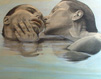
Edda Carminucci’s new paintings confirm her passion as a meticulous portrayer of emotions evoked by close-ups of male and female bodies that meet in a play of exchanged glances, of perplexed meditative identities reflected like prints on the lively surface of translucent, almost lacquered plates. Nimble bodies and faces tried by the moment that follows a displayed and consumed vitality look out of the painting like memory transfers. Women deep in thought, snuggled up, infatuated with their charm, like cover objects, reveal a silent animosity of aspirations, vague and sullen sentimental dispositions. The lacquered surface does not reproduce in its shape a physics of bodies, but one of a psychology that is expressed in the painting’s epithelium, reflecting lights and shadows, suggesting nervous movements, measured expression of physical and mental tension. The nature of the medium, which is generally wood, is very helpful to this figurative endeavour for the mobile vitality of its modulated texture made of colored planes. The artists seeks to reproduce – in the gestures, postures, photographic attitudes – the wonder of a woman’s “gaze” in search of inexpressible truths contained in meaning and emotion. The figures painted by Edda are transparent images, precisely like the memory of an experienced emotion filtered through the strong wood matter with lightly persistent vibrations producing the aesthetic effect of absorbed contemplation. Human faces of men and women are reflected as in a mirror in the enclosed garden of a unique anxiety: if Edward Munch’s lovers joined in a circle navigating entwined among the stars, the laying bodies depicted by Edda represent the distant trace of a gesture, or the mark of an existence separate from that of him who looks back, like the shadow of a past that does not return. The painting is meant to enumerate the clues and clearly show the passages of a vanished representation, simulating the sense of illusion with layers of light color that barely brush the surface, while the medium proves to be an indispensable visual complement. Edda does not seek tonal effects and is not captivated by form in itself: her intent is usually to obtain the desired aesthetic effect by leveraging on the plastic virtues of the media – paper, wood – in such a way as to allow their imaginative power to come to the fore through patient work of touch-ups diluted almost like a caress. Profiles and portraits alternate in a series of attitudes captured by surprise, and the snapshot’s impression returns them to us motionless, almost unnatural, as is always the case when life’s film is interrupted all of a sudden by an unexpected trauma or event. The scene depicted thus alludes to possible catastrophes, which are imminent or just happened, that shape the narration and suggest an imaginary plot of symbols and visions. Even the eye of a face, which generally stares into space, stresses the value of the image reflected in the precious moment of an endless pause, like a trace of fleeting life in time. Driven by the elegiac sentiment of memory and by an introverted gaze, Edda’s work is like a diary entry written on the sand, a manuscript inside a bottle floating on the sea, the transcribed document of a vivid past emotion. This lucid sentimental tension always guides the painter’s hand and supports her inspiration, which is expressed in the consistent quest for a style.
Duccio Trombadori
 Edda Carminucci